
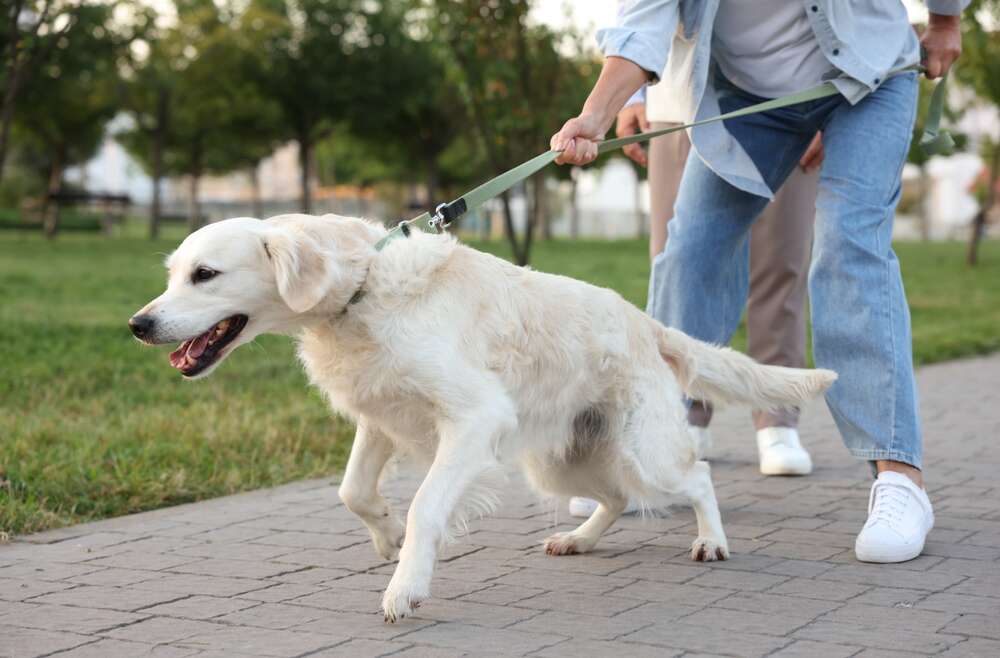
If you’ve ever stood in the pet store leash aisle feeling like you needed a degree to buy six feet of nylon, you are not alone. What looks like a wall of slightly different straps is actually a whole world of design choices — and the wrong one can turn a peaceful evening stroll into an arm-wrenching, tangle-prone wrestling match.
The good news: once you know what each type is for, picking the right one is easy. Here’s the honest rundown on the most common leashes, warts and all.
The Standard Flat Leash — The Reliable Workhorse
This is the leash you picture when someone says “dog leash”: a simple flat strap, usually four to six feet long, with a clip on one end and a loop handle on the other. It comes in nylon, leather, or rope.
Why it’s great: It’s the Swiss Army knife of leashes. Predictable length, solid control, and it works for training, neighborhood walks, and vet visits alike. Nylon is cheap, washable, and comes in every color imaginable. Leather is pricier but softer on the hands and ages beautifully.
Where it falls short: It doesn’t do anything fancy. There’s no give if your dog lunges, no hands-free option, and a soaking-wet nylon leash can give you a nasty rope burn if your pup bolts after a squirrel. Still, for most dogs and most owners, this is the one to start with.
The Retractable Leash — Convenient, Controversial
You know these: a plastic handle with a thin cord that extends up to fifteen or twenty feet at the press of a button. Dogs love the freedom. Trainers tend to wince.
Why people love them: Your dog gets to roam and sniff while you stay put, which is lovely in an open field or a quiet, empty path.
Where they get a bad rap: A lot. The thin cord can snap under a strong dog’s weight, cause painful cuts if it wraps around a leg (yours or the dog’s), and the constant slight tension actually teaches dogs to pull. Worst of all, when something goes wrong, you have almost no quick control — by the time you reel a dog in fifteen feet, the squirrel, the bike, or the other dog is already a problem. Best reserved for well-trained dogs in wide-open, low-traffic spaces, never busy sidewalks.
The Bungee (Shock-Absorbing) Leash — Easy on the Joints
A bungee leash has an elastic section built in that stretches and contracts, cushioning the jolt when your dog hits the end of the line.
Why it’s great: It’s kind to your shoulders, your back, and your dog’s neck. Runners and bikers love them, and so does anyone walking an enthusiastic puller while their training is still a work in progress.
Where it falls short: That same stretch makes it harder to give precise corrections, so it’s not ideal if you’re actively teaching loose-leash walking. The bungee can also become a slingshot if a big dog lunges and then the elastic recoils. Best as a comfort tool, not a training tool.
The Slip Lead — Simple, Fast, and Easy to Misuse
A slip lead is a single piece of rope or nylon with a loop on the end that tightens around the dog’s neck when there’s tension — basically a leash and collar in one, no clip required.
Why it’s handy: Shelters, groomers, and vets love them because they go on in two seconds flat with no fumbling for a collar. Great for quick in-and-out situations.
Where it gets risky: Because it tightens under pressure, a hard-pulling dog can essentially choke themselves. Many models include a stopper to limit how tight it gets — use one. This is a tool for short, supervised use by someone who knows what they’re doing, not an all-day walking leash for a dog that pulls.
The Martingale Leash — Gentle Anti-Escape Insurance
Borrowed from the martingale collar, this design has a limited-tightening loop that snugs up just enough to keep a dog from backing out of it, but stops short of choking.
Why it’s great: A lifesaver for sighthounds, whippets, and any “my head is smaller than my neck” breed that can Houdini their way out of a regular collar. It offers escape-proofing without the full choke risk of a slip lead.
Where it falls short: It still applies neck pressure, so it’s not the gentlest option for dogs with throat or trachea sensitivities. It also needs to be fitted correctly to work — too loose and it does nothing, too tight and it defeats the purpose.
The Hands-Free (Waist) Leash — For Runners and Multitaskers
This straps around your waist or across your body, leaving your hands free. Many include a bungee section for shock absorption.
Why it’s great: Perfect for jogging, hiking, or anyone who’s tired of juggling a leash, poop bags, a coffee, and their phone. Your dog stays connected while you keep your hands.
Where it falls short: If your dog lunges, you get yanked — sometimes right off your feet. Not a good pick for strong, reactive, or unpredictable dogs, and definitely not for situations where you might need to drop the leash fast. Great for trained dogs and active owners.
The Chain Leash — Tough but Heavy-Handed
A metal-link leash, often marketed as “chew-proof.”
Why people buy them: If your dog treats every leash like a chew toy, a chain can survive what nylon can’t.
Where it falls short: It’s heavy, can pinch your hands, gets cold and clunky, and honestly looks a bit intimidating. For most chewers, the better fix is training the dog not to chew the leash rather than upgrading to metal. A niche solution, not an everyday one.
The Long Line (Training Lead) — Freedom with a Safety Net
A long line is exactly what it sounds like: a leash that’s fifteen, thirty, even fifty feet long, usually flat nylon or biothane rope.
Why it’s great: It’s the secret weapon of recall training. Your dog gets to explore and feel free while you keep a literal lifeline attached, so you can practice “come” with real distance. Biothane versions are waterproof and easy to wipe clean after a muddy adventure.
Where it falls short: It is not a walking leash. All that slack tangles around legs, trees, and other dogs in a heartbeat, and it requires active management. Use it for open spaces and training sessions, then switch to something shorter for the sidewalk.
The Multi-Function (Adjustable) Leash — The Shape-Shifter
These have multiple rings and clips so you can adjust the length, wear them hands-free, clip two dogs together, or tether your dog to a post.
Why it’s great: Versatility. One leash that does five jobs is appealing if you don’t want a drawer full of single-purpose straps.
Where it falls short: Jack of all trades, master of none. The extra hardware adds weight and failure points, and the adjustments are rarely as quick or clean as a purpose-built leash. Handy for variety, but not always the best at any one task.
So… Which One Should You Actually Buy?
Here’s the cheat sheet:
- Just getting started, or want one solid all-rounder? Standard flat leash, four to six feet, nylon or leather.
- Training recall in open spaces? A long line.
- Running or hiking with a well-behaved dog? Hands-free, ideally with a bit of bungee.
- An escape artist with a slim head? A properly fitted martingale.
- A dog that pulls and hurts your shoulder? A bungee leash plus some loose-leash training.
And the one piece of advice that outranks all the gear: no leash replaces training. The best leash in the world is the one attached to a dog who’s learned how to walk nicely on it. Everything else is just a (very useful) backup plan.
Happy walking.

1 Comment
Cindy Jefferson
Vestibulum neque dolor pede dolor ornare massa, id vel eros erat, arcu mauris lacinia velit donec elementum, sed ac velit, tellus esse maecenas. Volutpat suscipit, elit sem consequat nec. Posuere et diam dui arcu et morbi, duis donec a, erat nibh vivamus tristique, justo nec id vestibulum. Etiam arcu tempus, scelerisque ullamcorper vestibulum, natoque massa porta, quisque fringilla metus, elit duis est faucibus. In integer.